Curation Isn't a Dirty Word — It's How I Finally Learned to Own My Story
Somewhere between the rise of the perfectly staged flat lay and the ten-thousandth "authentic" influencer living in a loft that looks like a furniture catalog, the word curated got poisoned. It started meaning fake. Performed. Carefully constructed for consumption by strangers. And honestly? I get it. I've side-eyed a few too many "candid" breakfast photos myself.
But here's the thing I keep coming back to: the problem was never curation. The problem was who we were curating for.
When Curation Became a Performance
Let's be real about how this happened. Social media rewarded a very specific kind of life-display — one that looked effortless while clearly being anything but. Suddenly, having a "curated aesthetic" meant you were either deeply cool or deeply fake, depending on who was judging. The word got tangled up in aspirational marketing, brand deals, and the particular exhaustion of performing a version of yourself that algorithms would reward.
No wonder people started treating curation like a confession of inauthenticity.
But if you strip all of that away — the audience, the metrics, the performance — what you're left with is something genuinely human. The act of choosing. Deciding what matters, what stays, what gets space in your home and your headspace and your days. That's not fake. That's actually just... living intentionally.
What It Looks Like When It's Really Yours
I have a friend in Chicago who collects vintage road maps. Not framed, not styled for Instagram — just stacked in a wooden crate in her living room, dog-eared and coffee-stained, pulled out whenever she wants to trace a trip someone took in 1974. She couldn't care less whether anyone finds it aesthetically cohesive. It's entirely for her. It tells a story about who she is: someone obsessed with the idea that every route has a history, that people have always been moving toward something.
That's curation. And it has nothing to do with a mood board.
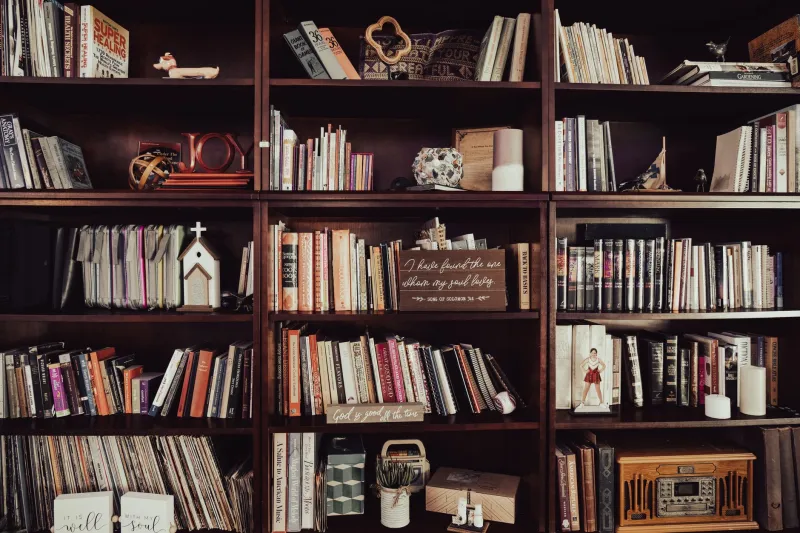
I've got my own version of this — a shelf that makes zero design sense but complete personal sense. There's a chipped mug I bought at a gas station in New Mexico, a stack of dog-eared paperbacks I reread every few years, a photo of my grandmother I printed at a drugstore because I kept meaning to frame it properly and then decided the imperfection was actually perfect. None of it matches. All of it is mine.
The difference between curation as self-definition and curation as performance is simple: one starts with the question what do I actually love? and the other starts with what will this say about me to other people?
Reclaiming the Word — and the Practice
Here's where I'm landing: thoughtfully choosing what gets space in your life is a radical act, especially right now. We live in a culture that is constantly trying to fill every corner of your attention, your closet, your schedule, your feed. Defaulting to more is the path of least resistance. Saying "this, but not that" takes actual intention.
When I started thinking about my life as something I was curating for myself — not for anyone scrolling past — everything shifted a little. I started asking different questions. Not "does this look good" but "does this feel like me?" Not "will people get it" but "does it make me happy when I see it?"
I cleared out things I'd kept because they seemed like things a person like me should have. Books I was supposed to have read. Decor that looked sophisticated but felt cold. A social calendar full of events I attended because opting out felt like a statement.
What I kept — and what I started adding — was stranger, more specific, more genuinely mine.
The Unconventional Collections That Tell the Truest Stories
The most interesting people I know have the most unexplainable collections. A guy in Brooklyn who keeps every concert ticket stub from shows he's attended since he was sixteen. A woman in Austin who photographs every meal she cooks — not for posting, just for herself, a private visual journal of her own creativity and mood. Someone I follow online who has a corner of their apartment dedicated entirely to things that are the color orange, for no reason other than it makes them unreasonably happy.
None of these are for anyone else. All of them are deeply curated. And all of them are more revealing and more real than any carefully staged aesthetic could be.
That's the thing about genuine curation: it's specific in a way that performance never quite manages to be. When you're choosing for yourself, you stop trying to be universally appealing and start being actually you — which is, weirdly, so much more compelling.
Permission to Choose
If curation is about anything, it's about permission. Permission to decide what gets your attention. Permission to say this matters and this doesn't, regardless of what's trending or what you're supposed to care about. Permission to build a life — visually, emotionally, practically — that reflects who you actually are rather than who you think you should appear to be.
That's what I'm trying to do here, on this site and in my actual life. Not perform a curated existence, but genuinely build one. Keep what's real, let go of what's just noise, and get honest about the difference.
It's messier than a mood board. It's also so much more interesting.
So yeah — I'm taking the word back. Curation isn't about perfection. It's about paying attention to your own life. And honestly? We could all use a little more of that.