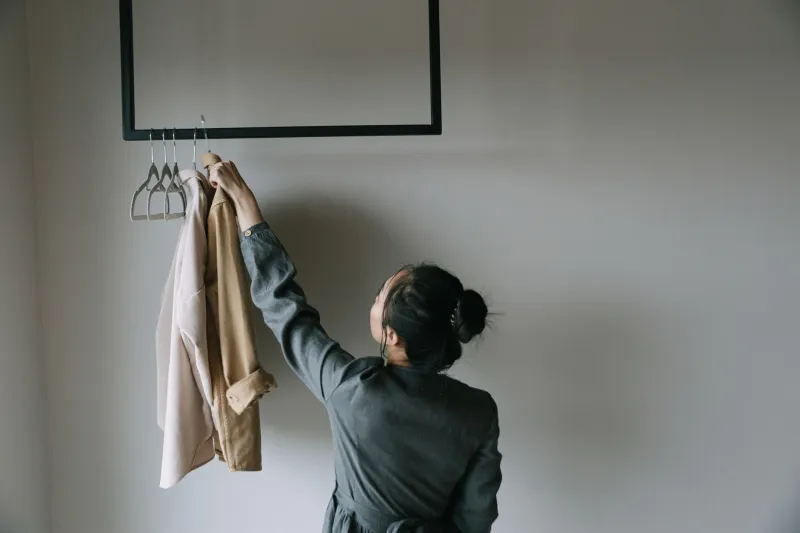
Stop Decorating Your Life for Other People: How to Build a Style That's Actually Yours

Photo by Photo by Vitaly Gariev on Unsplash on Unsplash
The Wardrobe That Looked Like Me But Wasn't
A few years ago, I had a closet that could have starred in a Pinterest board. Neutral palette, thoughtful pieces, the kind of effortless-looking collection that signals you've done the work of figuring yourself out. Except I hadn't. I'd done the work of figuring out what a certain kind of person was supposed to look like, and then I'd built that — meticulously, expensively — for myself.
I wore maybe a third of it regularly. The rest was aspirational costuming for a version of my life that existed mostly on screens.
I think a lot of us are living inside aesthetics we didn't actually choose. We assembled them from a thousand micro-influences — the accounts we follow, the neighborhoods we want to be perceived as belonging to, the version of cool that was dominant when we were first forming our tastes. And it looks fine, from the outside. It might even look great. But there's a particular kind of exhaustion that comes from performing a self rather than inhabiting one.
This is what I've been working on: the gap between the life I was curating and the life I actually want to live.
The Difference Between Taste and Aspiration
Taste is what you actually respond to when no one is watching. It's the thing you keep coming back to, the aesthetic that makes you feel like yourself rather than like a version of someone you're trying to become. Aspiration is what you want to be seen responding to.
Both are real. Both have a role. But when aspiration fully takes over — when every choice is made with an imaginary audience in mind — you end up with a life that functions more like a mood board than a home base.
The Instagram feed problem is real, but it's also a symptom of something deeper. Social media just made visible a thing humans have always done: perform identity for social approval. What's different now is the scale, the speed, and the constant feedback loop that trains you to optimize for engagement rather than authenticity.
When every aesthetic choice gets measured against how it lands externally, you lose the thread back to what you actually like.
Finding Your Non-Negotiables (The Real Ones)
Here's an exercise I started doing that genuinely shifted something for me: I started paying attention to what I kept returning to regardless of whether it was trending.
Not what I pinned. Not what I saved. What I actually wore on a random Tuesday when no one was coming over. What I put in my cart and then actually bought, versus what I added and abandoned. What I kept in my apartment after moving, versus what I donated without a second thought.
Your actual non-negotiables are in that data. They're quieter than your aspirational choices, and they're usually less photogenic. But they're the real architecture of your taste.
For me, when I started doing this honestly, I found: I care deeply about texture and fabric quality over silhouette. I gravitate toward warmth — ochre, rust, deep olive — not the cool, airy neutrals I'd been collecting. I wear the same three pairs of shoes constantly and ignore the rest. I actually love a little maximalism in my home and had been suppressing it because minimal was what looked better in photos.
None of this is revolutionary. But it was mine, and I hadn't been honoring it.
Editing Your Environment to Tell the Truth
Once you start identifying what you actually value aesthetically — as opposed to what you think you should value — the next step is editing your environment to reflect it. And that can feel surprisingly vulnerable.
There's comfort in aspirational aesthetics because they're legible. People understand them. They signal the right things. Letting that go in favor of something more personal means accepting that your space, your wardrobe, your life might not be immediately readable to everyone who encounters it.
But here's what I've found on the other side of that: consistency is its own kind of beauty. When your private life and your public life start to match — when the way you dress on a Saturday morning and the way you dress for an event aren't performing two different characters — there's a coherence that comes through. People feel it even if they can't name it.
Your home should feel like relief when you walk into it, not like a set. Your closet should feel like options, not obligations. The gap between how you live and how you want to be perceived is exactly as wide as your daily exhaustion.
The Freedom of Consistency
I want to be clear: this isn't about abandoning evolution or deciding your taste is fixed forever. Style should grow. What I'm talking about is building from the inside out rather than the outside in.
When your aesthetic is genuinely yours — built on what you actually love rather than what you think you're supposed to love — it becomes something that can absorb trends without being destabilized by them. You can try something new because it genuinely interests you, not because everyone else is doing it. You can skip something everyone else is into without feeling like you're missing out, because you have a clear enough sense of your own eye that you can recognize when something isn't for you.
That's the freedom I was chasing when I started this whole project of living more intentionally. Not freedom from aesthetics — I love beauty, I love clothes, I love the way a well-chosen object can make a room feel like it has a soul. But freedom from the exhausting performance of a self I didn't actually want to be.
Start With One Honest Audit
If any of this resonates, I don't think the answer is a dramatic overhaul. Start smaller: pick one area of your life — your closet, your bookshelf, the apps on your phone — and look at it with genuine honesty. Ask yourself what you'd keep if no one would ever see it. Ask yourself what you're holding onto because it says something about who you want to be perceived as, versus what you actually use and love.
The life that matches your values isn't louder or more impressive than the one you're performing. But it fits. And after years of wearing something that didn't quite fit, I can tell you — that feeling is worth everything.