I Stopped Decorating for Guests Who Weren't There — And Finally Came Home
The Apartment That Wasn't Mine
There was a throw pillow situation. Three of them, to be exact — linen, perfectly fluffed, arranged at an angle I'd seen on a home account I followed. They looked incredible. They also had to be moved every single time I wanted to actually sit on my couch.
That was the moment I started paying attention.
I'd spent the better part of two years turning my apartment into something I'd want to photograph. Neutral tones. Tasteful art prints. A little woven wall hanging I genuinely did not like but felt like I should have. My kitchen counter had a ceramic bowl full of lemons that I never touched. Why lemons? I don't even cook with lemons. But they looked like something a person with their life together would display, and so there they sat, slowly going soft.
My home was a performance. And the audience? Mostly hypothetical.
Who Are We Actually Designing For?
This is a question I think a lot of us avoid asking directly, because the honest answer is a little uncomfortable. When you zoom out and look at the choices you've made in your living space — the colors, the furniture arrangement, the things sitting on your shelves — who did you have in mind?
For me, it was a blurry composite. Part Instagram grid. Part imaginary houseguest with impeccable taste. Part some version of myself I thought I was supposed to be by now. None of it was the actual me who comes home exhausted on a Tuesday and just wants to feel held by her surroundings.
We talk a lot about authenticity in how we dress, how we show up online, how we talk about our lives. But we don't talk nearly enough about the spaces we physically inhabit — the ones that either replenish us or quietly drain us, depending on whether they were built for real life or for optics.
The Stripping Away
I didn't do a dramatic overhaul all at once. It started small. I moved the throw pillows to my closet shelf and just... didn't replace them. I sat on my couch that night and noticed how much easier it was to just be there. No adjusting. No resetting.
Then I looked at the lemon bowl. I tossed the lemons, washed the bowl, and put it away. The counter looked emptier. For about a week, it bothered me. Then it stopped bothering me, and I realized the emptiness I was seeing was actually just space — and I'd been so afraid of space that I'd filled every surface with things that didn't mean anything to me.
Over the following month, I went room by room. Not with a design plan, but with a single question: Does this make my actual daily life better or worse?
The woven wall hanging came down. The shelf of books I'd bought to look well-read got edited down to the ones I'd actually finished and loved. The accent chair that was too stiff to sit in for more than ten minutes — gone, replaced with a floor cushion that I now use constantly. I repainted my bedroom from a trendy sage that photographed beautifully to a warm off-white that makes me feel calm every morning when I open my eyes.
None of these changes would have made a great post. All of them made my life measurably better.
What I Found Underneath the Aesthetic
Here's what surprised me: once I stopped designing for an imagined eye, I started to discover what I actually like. Not what I thought I should like, or what looked good in a certain light, but genuine preference.
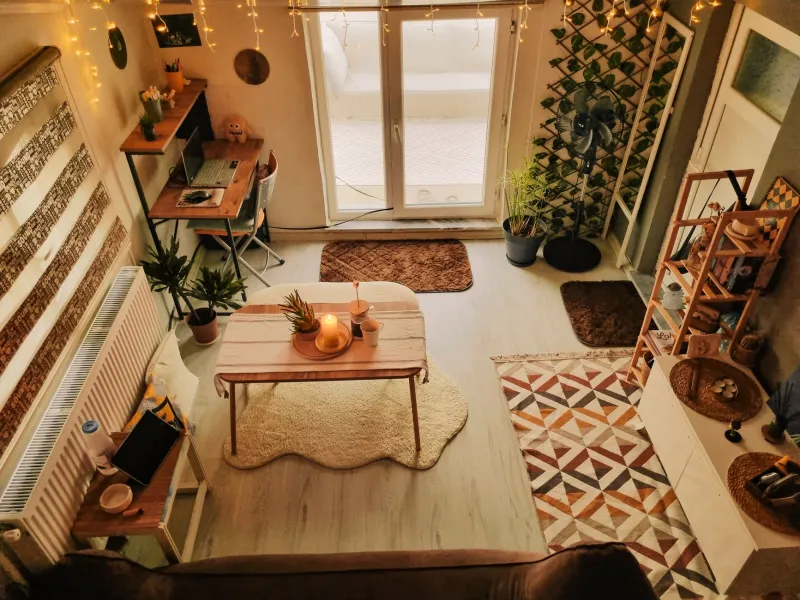
Turns out I love color — deep, saturated, unapologetic color — which I'd been suppressing in favor of the muted palette I thought made a space look sophisticated. I love a little visual chaos, books stacked sideways, a mix of textures that don't necessarily match. I love having my workspace feel cozy rather than minimal, which meant adding a small lamp and a plant instead of keeping the clean lines I'd maintained for appearances.
My home started to feel like me. Which sounds like it should be obvious, but it genuinely wasn't before.
There's something almost radical about a space that tells the truth about who you are — not who you're aspiring to project, but who you actually are right now, today, with all your weird preferences and comfort needs intact.
Your Home Is a Wellness Practice
I've come to think of this as a form of wellness that we chronically undervalue. We talk about sleep hygiene, morning routines, movement practices — and those things matter. But we spend enormous amounts of time inside our homes, and the emotional register of those spaces has a real effect on how we feel.
A room that doesn't fit you is low-grade friction. It's the subtle exhaustion of living somewhere that wasn't designed with you in mind — even when you were technically the one who designed it.
And the inverse is also true. A space that genuinely reflects you, that prioritizes your comfort and your actual routines, becomes something restorative. You walk in and your nervous system relaxes because the environment is saying you belong here in a language you understand.
That's not a small thing.
The Ongoing Edit
I want to be clear that this isn't a finished project. I don't have the perfectly curated home now — I have a more honest one, which is different. There are still things I'm figuring out. A corner of my living room that doesn't quite work yet. A bathroom I haven't touched because I keep defaulting to what looks good on a shelf versus what I actually reach for.
But I've changed the question I'm asking. It's not what would look good here? It's what would make me feel good here? Those two questions lead to very different answers, and I'm still learning to trust the second one.
The throw pillows, for the record, are still in the closet. I haven't missed them once.
If your home feels like something you're maintaining rather than somewhere you're living — it might be time to ask yourself who you built it for. The answer might surprise you. And the redesign that follows might be the most personal thing you do all year.